
It’s essential to have access to money, move it around, and pay bills as long term travelers. If something goes wrong it’s not as easy as simply running down to the bank to get it resolved. In our case we have our IRA’s with two different major companies as well an account with a local Florida bank. Aside from the Financial Power of Attorney (covered elsewhere) we spent time thinking about the tactical, day to day, aspects of getting cash, making purchases, and paying bills (credit card and insurance mainly). From our perspective, it’s all about minimizing ATM fees and redundancy.
Credit Cards and Risks of Locked Accounts
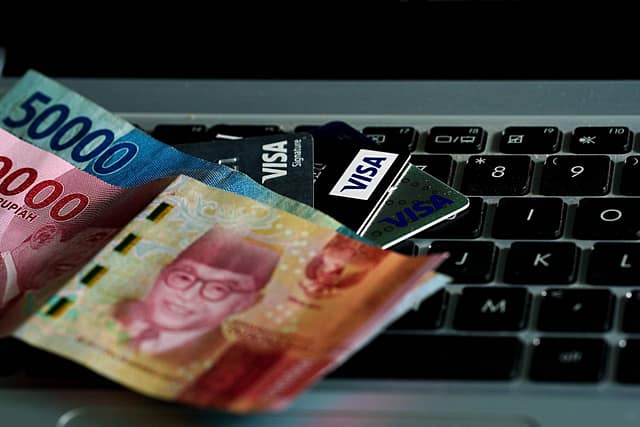
Thankfully, most credit card companies no longer require you to set travel notices before going overseas. Credit cards just work – assuming the vendor/country accepts them. Visa seems to be good almost everywhere. However, we are still a bit on edge should a bank decide something is fraudulent and locks the card. There is also the risk that a card gets lost/stolen. So, planning ahead, we realized our cards were all issued by one major bank, so we added another credit card from a completely different bank.
Pulling Cash at ATMs
While China is virtually cashless, they are by far the exception. Getting cash is extremely important everywhere else. However, ATM fees are very significant and add up. To us these are a waste. There are a few companies, mainly associated with brokerages, that offer cash/checking accounts with ATM rebates – even if you don’t actually trade with their brokerage. In the spirit of redundancy we setup two of these accounts, with two different companies allowing both cash withdrawal and ATM fee rebates. They also allow bill payment should we have a problem with our traditional bank account for some reason.
The Problems With Two Factor Authentication
One of the biggest pains in the modern banking system is two-factor authentication (2FA). As much as 2FA with text message (SMS) is a huge security risk, few institutions will allow security keys or authenticator apps. Many don’t allow them at all, or won’t use them exclusively, always allowing insecure SMS. So the ability to receive SMS is a must.
We’ve had Verizon for years and they are extremely expensive, especially for international roaming. I had planned to dump them entirely and leverage SMS via Google Voice. However…. Google Voice is a Voice over IP service, and many banks either won’t allow it or at some unknown point will just refuse to send messages to it. So we were back to needing real phone numbers, in the US. In the end, we settled on one of the low monthly cost phone providers. For a few dollars a month we could maintain a US phone number and receive free text messages over Wi-Fi.
With a modern smartphone (Samsung S25 in our case) we can keep our US plan as an eSIM to receive 2FA codes. This allows us flexablity to also add either a travel eSIM (Holafly, Airalo, etc) or foreign carrier in each country we travel to, either as eSIM or physical SIM.
In Summary - Managing Finances as Slow Travelers
Our objective is to build in redundancy within our financial management and minimize ATM fees. We’ve chosen to ensure we have credit cards issued by multiple national banks, maintain cash accounts with two brokerages that offer ATM fee reimbursement, as well as a checking account with a local Florida bank for most bill payment.
Finally, like it or not, two factor authentication is a requirement for banks, brokerage houses, and credit cards. VoIP based phone numbers won’t cut it, so you need a real US phone number. For us, it meant abandoning Verizon Wireless in favor of a low cost phone provider that won’t break the bank.
This post is part of a larger series covering our approach to getting our affairs together and estate planning ahead of a long adventure in slow travel around the world. Read more background on this series or jump to other topics in the series.
For more on security see how my experiences shaped my approach to security.